
The Guidepost Test: Six Questions for Advice That Builds Independence
Advice is everywhere. Useful orientation is much rarer.
A person facing a business decision, an administrative dispute, a record problem, a family transition, or a major life change can collect enormous amounts of information without becoming more capable of acting. The central question is not merely whether a source sounds confident. It is whether the relationship leaves you with greater understanding, stronger records, and more ownership of the next decision.
In *Apex Prey: Apex Predator — The Legacy*, TYB writes:
“We are not interested in preserving dependency. We are interested in increasing understanding.”
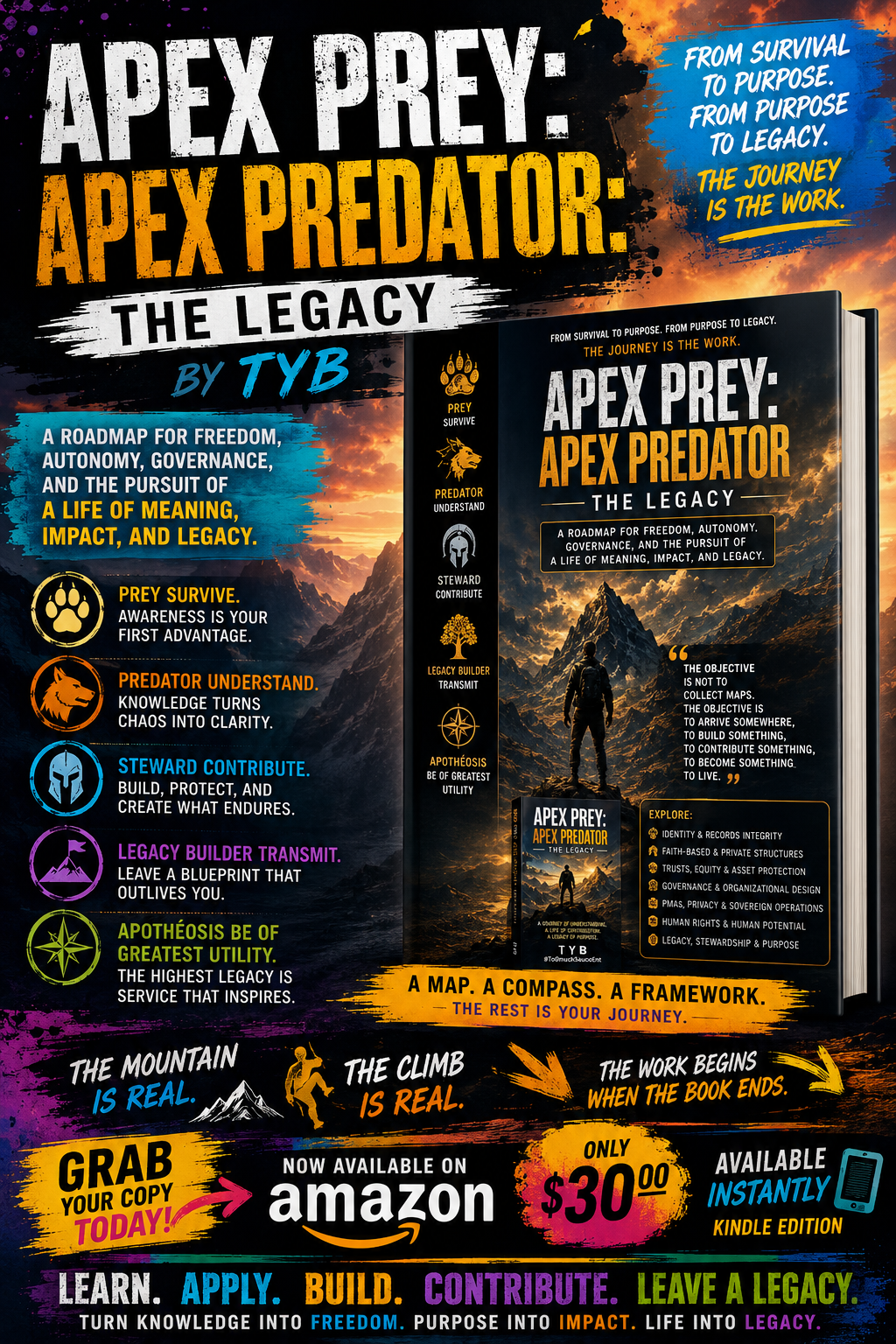
That sentence creates a practical standard. A guide should help you see the terrain, distinguish facts from assumptions, and understand why a proposed step belongs where it does. The goal is not permanent dependence on the guide. The goal is disciplined independence.
Here is a six-question test for evaluating advice before you organize your time, money, records, or expectations around it.
1. Does the guide separate verified facts from interpretation?
Good guidance makes its footing visible. It distinguishes what a document actually says, what a source confirms, what remains disputed, and what is only an inference. Confidence is not a substitute for that separation.
Ask for the underlying source. Identify the date, version, author, issuing institution, or governing record. If the advice depends on an unstated assumption, place that assumption in writing. A visible assumption can be tested. A hidden assumption silently controls the entire plan.
2. Can the guide explain the map without demanding blind faith?
Direction is stronger when you can understand the route. A useful guide should be able to describe the current position, the desired destination, the major decision points, and what evidence would change the route.
This does not mean every field is simple or every answer is certain. It means complexity is organized instead of used as a curtain. If the only explanation is “trust me,” you have not received a map. You have received a command.
3. Are the limits, risks, and alternatives visible?
Real decisions have constraints. Deadlines expire. Records conflict. Institutions use different procedures. Costs and tradeoffs exist. No responsible guide can promise that organization alone controls an outside decision-maker.
A sound recommendation should identify what it can accomplish, what it cannot accomplish, the most important risks, and at least one reasonable alternative. This gives you a basis for informed choice instead of manufactured urgency.
4. Does the process create a record you can independently verify?
Verbal guidance can disappear. A usable process leaves a trail: source documents, dated notes, a decision log, proof of submission, assigned tasks, and a record of what remains open.
The test is simple: if the guide became unavailable tomorrow, could you reconstruct what happened and why? If not, the process is storing critical knowledge inside a person instead of inside a reliable system.
5. Does every recommendation become an owned next action?
Information is not movement until someone owns a specific action. A strong next step identifies the responsible person, the required input, the deadline, the proof of completion, and the condition that triggers escalation or reconsideration.
“Research this further” is not yet an action plan. “Obtain the dated agency record, compare it to the submission receipt, log the discrepancy, and preserve the response deadline” is reviewable and executable.
6. Is the relationship increasing your capacity to proceed without it?
This is the final Guidepost Test. After each interaction, are you more capable of identifying reliable sources, organizing records, evaluating options, and explaining your own decision? Or has the process made the subject feel more mysterious and the adviser more indispensable?
A legitimate guide may remain valuable for specialized knowledge, experience, or perspective. But value should not depend on keeping the client confused. The relationship should make the terrain clearer.
Build a one-page Guidepost Record
For an important decision, create a single page with six fields:
1. Verified facts.
2. Open assumptions.
3. Available paths.
4. Risks and constraints.
5. Next action, owner, deadline, and proof.
6. The point at which outside guidance is no longer required—or must be escalated to an appropriately licensed professional.
This one-page record does not decide the matter for you. It exposes whether the advice has produced understanding or merely dependence.
The broader message of *Apex Prey* is not domination. It is discernment, stewardship, purpose, and the ability to move through systems intentionally. A worthy guide helps you locate the mountain. The climb remains yours.
Explore *Apex Prey: Apex Predator — The Legacy*: https://www.amazon.com/dp/B0H5QWHZTL
If your matter involves a document-heavy administrative process, TOFG can help organize the source record, discrepancy trail, submissions, and next-action ledger: https://www.the-opulent-fountain-group-experience.com/service-page/administrative-agency-record-challenge?utm_source=wix_blog&utm_medium=owned_content&utm_campaign=guidepost_test_20260829&utm_content=authority_post
TOFG provides nationwide pro se support, research and document-organization services. TOFG is not a law firm and does not provide legal representation.


Comments